
Английский язык 10 класс учебник Ваулина, Дули ответы – страница 68

- Тип: ГДЗ, Решебник.
- Авторы: Ваулина Ю. Е., Дули Д., Подоляко О. Е.
- Часть: без частей.
- Год: 2026.
- Серия: Школа России (ФГОС).
- Издательство: Просвещение.

4c GRAMMAR IN USE
4c ИСПОЛЬЗОВАНИЕ ГРАММАТИКИ
MODALS (GRAMMAR REFERENCE)
МОДАЛЬНЫЕ ГЛАГОЛЫ (СПРАВОЧНИК ПО ГРАММАТИКЕ)
Номер 1.
a) Match the sentences (1–7) with their meanings (A–G).
a) Сопоставь предложения (1–7) с их значениями (A–G).
1) You mustn’t drop litter in the streets.
2) You can’t use your camera in here, I'm afraid.
3) You have to have a licence to own an exotic pet.
4) I don’t have to use my car every day.
5) We should/ought to / had better cycle to school.
6) You shouldn’t leave the tap running when you're brushing your teeth.
7) We must try to save energy at home and at work.
A. It’s important for you to do so.
B. It’s not necessary / obligatory.
C. You don’t have permission.
D. It’s not a good idea — I don't recommend it.
E. It’s not allowed.
F. It’s the law.
G. It’s the best / right thing to do.
Перевод:
1) Нельзя выбрасывать мусор на улицу.
2) Боюсь, вы не можете использовать здесь свою камеру.
3) Для содержания экзотического животного необходима лицензия.
4) Мне не обязательно пользоваться машиной каждый день.
5) Нам следует / стоит / лучше ездить в школу на велосипеде.
6) Не следует оставлять кран открытым, когда чистишь зубы.
7) Мы должны стараться экономить энергию дома и на работе.
А. Это важно для вас.
B. Это не обязательно.
C. У вас нет разрешения.
D. Это плохая идея — я не рекомендую.
Е. Это не разрешено.
F. Это закон.
G. Это лучшее / правильное решение.
1) — E.
2) — C.
3) — F.
4) — B.
5) — G.
6) — D.
7) — A.
b) Which of the verbs in bold expresses: obligation / necessity? absence of necessity? permission / prohibition? What are the equivalents in your language?
b) Какой из выделенных жирным шрифтом глаголов выражает: обязанность / необходимость? отсутствие необходимости? разрешение / запрет? Какие эквиваленты есть в твоем языке?
Obligation / necessity
• must
• have to
• should / ought to / had better
Absence of necessity
• don’t have to
Permission / prohibition
• can
• can’t / mustn’t
Перевод:
Обязанность / необходимость
• должен, обязан
• должен, приходится
• следует, стоит, лучше бы
Отсутствие необходимости
• Не обязательно, не нужно
Разрешение / запрет
• можно, разрешено
• нельзя, запрещено
Номер 2.
Choose the most appropriate modal verb to complete the dialogue. Listen and check.
Выбери наиболее подходящий модальный глагол для завершения диалога. Прослушай и проверь.
A: We’re having an environmental awareness day at school tomorrow.
B: Environmental awareness day? What’s that?
A: It’s a special day when we learn about all the things we 1) should / have to do to protect the environment. You know, how we 2) have to / can help to save the planet.
B: That sounds interesting. What do you do?
A: Well, for a start, everybody 3) had better / should walk or cycle to school so that we don’t pollute. And we 4) can’t / must make sure we don't waste energy when we are there.
B: How do you do that?
A: To begin with, we remind everybody of what they 5) can / don’t have to do to save energy.
B: Like turning lights off in empty rooms, you mean?
A: That's right. We have a rule that the last person to leave a room 6) can / must turn off the lights and close the door.
B: Why do you 7) must / have to close the door?
A: To keep the heat in, of course! You 8) should / can never leave doors open because heat will escape!
B: Goodness! I never thought of that! I think we 9) had better / have to have an environmental awareness day at my school, too!
A: We’re having an environmental awareness day at school tomorrow.
B: Environmental awareness day? What's that?
A: It’s a special day when we learn about all the things we 1) should do to protect the environment. You know, how we 2) can help to save the planet.
B: That sounds interesting. What do you do?
A: Well, for a start, everybody 3) should walk or cycle to school so that we don’t pollute. And we 4) must make sure we don't waste energy when we are there.
B: How do you do that?
A: To begin with, we remind everybody of what they 5) can do to save energy.
B: Like turning lights off in empty rooms, you mean?
A: That's right. We have a rule that the last person to leave a room 6) must turn off the lights and close the door.
B: Why do you 7) have to close the door?
A: To keep the heat in, of course! You 8) should never leave doors open because heat will escape!
B: Goodness! I never thought of that! I think we 9) have to have an environmental awareness day at my school, too!
Перевод:
А: Завтра в школе день экологической осведомленности.
B: День экологической осведомленности? Что это такое?
А: Это особый день, когда мы узнаём обо всём, что мы 1) должны делать, чтобы защитить окружающую среду. Знаешь ли, как мы 2) можем помочь спасти планету.
B: Звучит интересно. Что вы делаете?
А: Ну, для начала, всем 3) следует ходить пешком или ездить на велосипеде в школу, чтобы не загрязнять окружающую среду. И мы 4) должны следить за тем, чтобы не тратить энергию впустую, когда находимся там.
B: Как вы это делаете?
А: Для начала мы напоминаем всем, что они 5) могут сделать, чтобы сэкономить энергию.
B: Например, выключать свет в пустых комнатах, ты имеешь в виду?
А: Верно. У нас есть правило, что последний человек, покидающий комнату, 6) должен выключить свет и закрыть дверь.
B: Почему 7) нужно закрывать дверь?
А: Конечно, чтобы сохранить тепло! 8) Никогда не оставляй двери открытыми, потому что тепло будет уходить!
B: Боже мой! Я никогда об этом не задумывался! Думаю, нам тоже нужно провести день экологической осведомленности в моей школе!
Номер 3.
Use modal verbs and the verbs in the list to explain the signs.
Используй модальные глаголы и глаголы из списка, чтобы объяснить знаки.
• leave
• smoke
• go in
• recycle
• swim
1. NO LITTER
2. ENTRANCE — RECYCLE CENTRE
3. NO SWIMMING
4. NO SMOKING
5. PHONE BOOKS ONLY — NO MAGAZINES / CATALOGUES
Example:
1. You mustn’t leave litter here.
1. You mustn’t leave litter here.
2. You can go in the recycle centre here.
3. You mustn’t swim here.
4. You mustn’t smoke here.
5. You mustn’t recycle magazines or catalogues here, only phone books.
Перевод:
1. Здесь нельзя оставлять мусор.
2. Вы можете воспользоваться пунктом приема вторсырья здесь.
3. Здесь нельзя купаться.
4. Здесь нельзя курить.
5. Здесь нельзя сдавать на переработку журналы или каталоги, только телефонные справочники.
Номер 4.
Make true sentences about your country. Use modals.
Составь правдивые предложения о своей стране. Используй модальные глаголы.
• car drivers / wear seat belts
• you / pay for local phone calls
• citizens / carry identity cards
• smokers / smoke in public places
• passengers / eat on public transport
• teenagers / leave school at 16
Example:
Car drivers have to wear seat belts.
• You don’t have to pay for local phone calls from a landline, but mobile calls are usually paid.
• Citizens have to carry identity cards since they are 14.
• Smokers mustn't smoke in public places.
• Passengers can eat on public transport.
• Teenagers can leave school at 16, or even earlier, as soon as they finish the 9th grade.
Перевод:
• За местные телефонные звонки со стационарных телефонов платить не нужно, но звонки с мобильных телефонов обычно платные.
• Граждане обязаны иметь удостоверение личности с 14 лет.
• Курящим запрещено курить в общественных местах.
• Пассажирам разрешено есть в общественном транспорте.
• Подростки могут закончить учёбу в школе в 16 лет или даже раньше, сразу после окончания 9-го класса.
Номер 5.
Study the table and then complete the sentences.
Изучи таблицу, а затем дополни предложения.
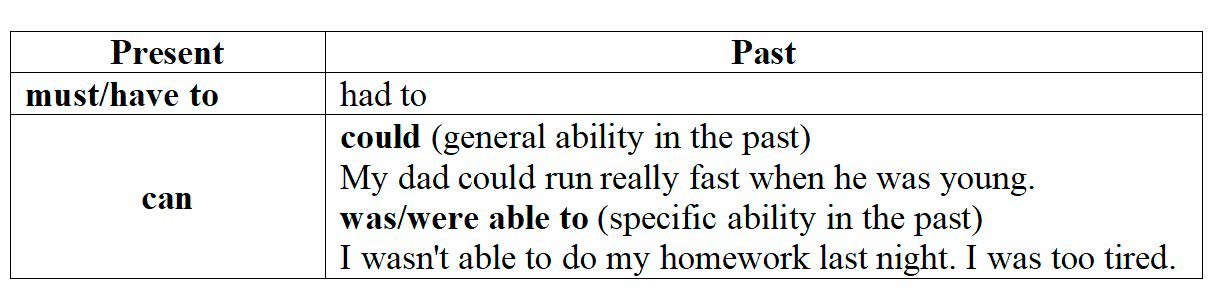
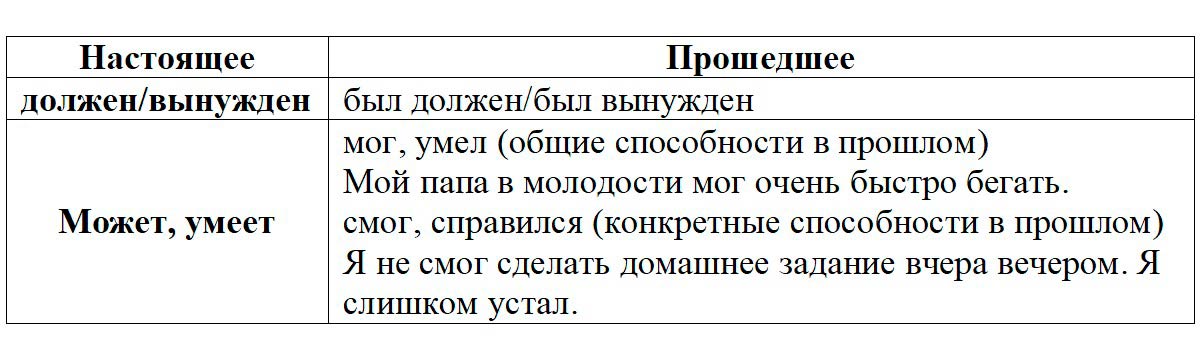
1. Before they built those houses, you ..... see the sea from here.
2. I was late yesterday because I ..... go to the dentist.
3. She didn’t know that she ..... take her old mobile phone to the recycling centre.
4. When I was young, I ... help my mother clean the house every day.
5. It was difficult, but I ..... answer all the questions correctly in the end.
1. Before they built those houses, you could see the sea from here.
2. I was late yesterday because I had to go to the dentist.
3. She didn’t know that she could take her old mobile phone to the recycling centre.
4. When I was young, I had to help my mother clean the house every day.
5. It was difficult, but I was able to answer all the questions correctly in the end.
Перевод:
1. До того, как построили эти дома, отсюда было видно море.
2. Я опоздал вчера, потому что мне нужно было к стоматологу.
3. Она не знала, что может сдать свой старый мобильный телефон в пункт приема вторсырья.
4. В детстве мне приходилось каждый день помогать маме убирать дом.
5. Было сложно, но в итоге я смог правильно ответить на все вопросы.
С подпиской рекламы не будет
Подключите премиум подписку со скидкой в 40% за 149 ₽






Напишите свой комментарий.