
Английский язык 4 класс учебник Афанасьева, Михеева 2 часть ответы – страница 42
- Тип: ГДЗ, Решебник.
- Авторы: Афанасьева О. В., Михеева И. В., Баранова К. М.
- Учебники: Rainbow + Dialogue.
- Часть: 2.
- Год: 2021-2023.
- Серия: Школа Диалога.
- Издательство: Просвещение.


Step 2 – Шаг 2
Do It Together – Выполните вместе
Номер 1.
Послушай четыре разговора, (132), и реши, где происходит каждый из них.
a) In the street.
b) In the cafe.
с) At school.
d) In the kitchen.
a) In the street. – Number 4.
b) In the cafe. – Number 3.
с) At school. – Number 1.
d) In the kitchen. – Number 2.
Перевод:
a) In the street. – Number 4 – На улице. – Номер 4.
b) In the cafe. – Number 3 – В кафе. – Номер 3
с) At school. – Number 1. – В школе. – Номер 1.
d) In the kitchen. – Number 2. – На кухне. – Номер 2.
Текст аудирования:
Number 1.
– Excuse me, can you help me?
– Yes. What’s the matter?
– I’m reading a text and I don’t understand it.
– OK. I think I can help you. Where’s the text?
Number 2.
– Hi! What are you doing?
– I’m washing the plates.
– Can I help you with it?
– Oh, thank you very much.
Number 3.
– Are you enjoying your lunch?
– Yes, it is very good. I think it is very tasty.
– What would you like to drink, sir?
– Can I have some mineral water?
– Yes.
Number 4.
– Where are you going?
– I’m taking the dog out.
– Do you always take him out in the afternoon?
– No. But I’m taking him out today. I’m going for a walk in the park.
– Can I go with you?
– I’m sorry, you can’t. Not today.
Перевод текста аудирования:
Number 1. – Номер 1.
Excuse me, can you help me? – Извините, вы не могли бы мне помочь.
Yes. What’s the matter? – Да. В чем дело?
I’m reading a text and I don’t understand it. – Я читаю текст и ничего не понимаю.
OK. I think I can help you. – Хорошо. Думаю, я могу помочь тебе.
Where’s the text? – Где текст?
Number 2. – Номер 2.
Hi! What are you doing? – Привет! Что ты делаешь?
I’m washing the plates. – Я мою тарелки.
Can I help you with it? – Могу я чем-нибудь помочь тебе?
Oh, thank you very much. – О, большое вам спасибо.
Number 3. – Номер 3
Are you enjoying your lunch? – Вам понравился обед?
Yes, it is very good. – Да, он очень вкусный.
I think it is very tasty. – По-моему, это очень вкусно.
What would you like to drink, sir? – Что бы вы хотели выпить, сэр?
Can I have some mineral water? – Можно мне немного минеральной воды?
Yes. – Да.
Number 4. – Номер 4.
Where are you going? – Куда ты идешь?
I’m taking the dog out. – Я выгуливаю собаку.
Do you always take him out in the afternoon? – Ты всегда выгуливаешь собаку после обеда?
No. But I’m taking him out today. – Нет. Но сегодня я забираю его с собой.
I’m going for a walk in the park. – Я собираюсь прогуляться в парке.
Can I go with you? – Можно мне пойти с тобой?
I’m sorry, you can’t. – Прости, но ты не можешь.
Not today. – Не сегодня.
Номер 2.
Прочитай следующие слова и словосочетания. Проверь себя, (133).
А.
[ɒ]: water, was, what, watch, often
[ʒ:]: fern, her, were, bird, sir
[ɑ:]: class, last, classroom, garden, armchair
[əʊ]: ago, piano, lotto, photo
[e]: men, then, tent, hen, pen
B.
last Monday
last Tuesday
last Thursday
last Wednesday
was twelve then
was thirty then
was forty-five then
was sixty then
were in the park
were in the garden
yesterday evening
yesterday morning
yesterday afternoon
yesterday night
three weeks ago
seven days ago
six months ago
ten years ago
were in town
were at the cinema
А.
water-вода, was-был, what-что, watch-смотреть, often-часто
fern-папоротник, her-ее, were-были, bird-птица, sir-сэр
class-класс, last-последний, classroom-класс, garden-сад, armchair-кресло
ago-тому назад, piano-пианино, lotto-лото, photo-фото
men-мужчины, then-затем, tent-палатка, hen-курица, pen-ручка
B.
last Monday – в прошлый понедельник
last Tuesday – в прошлый вторник
last Thursday – в прошлый четверг
last Wednesday – в прошлую среду
was twelve then – затем было двенадцать (тогда мне было двенадцать)
was thirty then – затем было тридцать (тогда мне было тринадцать)
was forty-five then – затем было сорок пять
was sixty then – затем было шестьдесят
were in the park – были в парке
were in the garden – были в саду
yesterday evening – вчера вечером
yesterday morning – вчера утром
yesterday afternoon – вчера днем
yesterday night – вчера ночью
three weeks ago – три недели назад
seven days ago – семь дней назад
six months ago – шесть месяцев назад
ten years ago – десять лет назад
were in town – были в городе
were at the cinema – были в кинотеатре
Номер 3.
Выбрав правильную форму глагола, заверши эти предложения.
1) Mr Robinson and his wife (was / were) at the cinema yesterday night. Their pets were at home.
2) My friends and I (was / were) at school yesterday afternoon.
3) Last summer my grandparents (was / were) in Spain, I (was / were) in London with my parents then.
4) I think John Barker (was / were) in his garden yesterday evening.
5) Sally Barker (was / were) at home five days ago.
6) We (was / were) in the bank last Wednesday.
7) They all (was / were) at the zoo a week ago.
8) My cousin (was / were) in the cafe yesterday.
1) Mr Robinson and his wife were at the cinema yesterday night. Their pets were at home.
2) My friends and I were at school yesterday afternoon.
3) Last summer my grandparents were in Spain, I was in London with my parents then.
4) I think John Barker was in his garden yesterday evening.
5) Sally Barker was at home five days ago.
6) We were in the bank last Wednesday.
7) They all were at the zoo a week ago.
8) My cousin was in the cafe yesterday.
Перевод:
1) Mr Robinson and his wife were at the cinema yesterday night. – Мистер Робинсон и его жена вчера вечером были в кино.
Their pets were at home. – Их домашние животные были дома.
2) My friends and I were at school yesterday afternoon. – Вчера днем мы с друзьями были в школе.
3) Last summer my grandparents were in Spain, I was in London with my parents then. – Прошлым летом мои бабушка и дедушка были в Испании, а я тогда был в Лондоне с родителями.
4) I think John Barker was in his garden yesterday evening. – Я думаю, вчера вечером Джон Баркер был в своем саду.
5) Sally Barker was at home five days ago. – Салли Баркер была дома пять дней назад.
6) We were in the bank last Wednesday. – В прошлую среду мы ходили в банк.
7) They all were at the zoo a week ago. – Неделю назад они все были в зоопарке.
8) My cousin was in the cafe yesterday. – Вчера мой двоюродный брат был в кафе.
Номер 3.
Дополни предложения словами из рамки и прочитай их вслух.
knife, tea spoons, sugar bowl, cups, teapot, the forks
1) Put some sugar in the , please.
2) Let's make tea. Where is the ?
3) It's tea time. I'm putting three and three on the table.
4) I had to wash the plates and after dinner.
5) Ann, can you give me a , please? I'd like to have some bread.
1) Put some sugar in the cups, please.
2) Let's make tea. Where is the teapot?
3) It's tea time. I'm putting three tea spoons and three sugar bowl on the table.
4) I had to wash the plates and the forks.
5) Ann, can you give me a knife, please? I'd like to have some bread.
Номер 4.
Посмотри на картинку и скажи, какие предметы находятся на столе и сколько их.
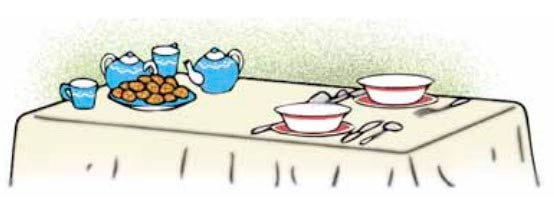
On the table there are two bowls, two knives, two forks.
On the table you can see two cups, two teapots and a bowl with biscuits.
Номер 5.
Прочитай диалог и ответь на вопросы после него.
Sue: Linda, granny phoned a minute ago. She is going to come home at around five.
Linda: That's wonderful. Let's have tea together.
Sue: OK. I'm going to make tea. Can you put the tea things on the table?
Linda: Yes, I can. Where is granny's favourite cup?
Sue: It is in the cupboard behind the bowls. The teapot and the sugar bowl are there too.
Linda: Thanks. So, we've got three cups, three tea spoons and the sugar bowl here. I must remember the milk jug. Granny likes tea with milk.
Sue: Where are the biscuits and the chocolates?
Linda: They must be on the shelf. Let's put them on the table too.
Sue: Here goes the doorbell'. It must be Granny.
1) Who phoned a minute ago?
2) Who is going to visit Linda and Sue at around five?
3) Who is going to put cups, tea spoons and a sugar bowl on the table?
4) Who likes tea with milk?
1) Grandmother phoned a minute ago.
2) Grandmother is going to visit Linda and Sue at around five.
3) Linda is going to put cups, tea spoons and a sugar bowl on the table.
4) Grandmother likes tea with milk.
Перевод:
Сью: Линда, бабушка звонила минуту назад. Она собирается вернуться домой около пяти.
Линда: Это замечательно. Давайте вместе выпьем чаю.
Сью: Хорошо. Я сделаю чай. Ты можешь поставить чайные принадлежности на стол?
Линда: Да, могу. Где бабушкина любимая чашка?
Сью: Она в шкафу за чашками. Заварочный чайник и сахарница тоже там.
Линда: Спасибо. Итак, у нас здесь три чашки, три чайные ложки и сахарница. Я должна вспомнить про кувшин с молоком. Бабушка любит чай с молоком.
Сью: А где печенье и шоколадные конфеты?
Линда: Они должны быть на полке. Давай поставим их на стол тоже.
Сью: Вот и дверной звонок. Это, наверное, бабушка.
1) Кто звонил минуту назад?
2) Кто собирается прийти к Линде и Сью около пяти часов?
3) Кто поставит на стол чашки, чайные ложки и сахарницу?
4) Кто любит чай с молоком?
При образовании множественного числа имён существительных, оканчивающихся на букву f(e), происходят изменения в написании конца слов: буква f часто меняется на v и к концу слова прибавляется окончание -es.
knife – knives, shelf – shelves, wite – wives, leat – leaves
С подпиской рекламы не будет
Подключите премиум подписку со скидкой в 40% за 149 ₽







Напишите свой комментарий.